

The hotline is currently not manned. You can reach us again on Wednesday, 07.10.2026 at 09:30.

"Virtual Analog" Redefined!
Inspired by the legendary KORG Mono/Poly, the KORG multi/poly Analog Modeling Synthesizer delivers impressive virtual analog sounds that offer outstanding flexibility thanks to powerful digital technology.
The original Mono/Poly used four oscillators and was known for its unusually full sound as well as its unique, experimental features like flexible cross-modulation and sync routings and the "Round Robin"-style triggering of individual oscillators. This made the Mono/Poly the first compact, user-friendly instrument to offer features previously only achievable in large modular systems.
The new multi/poly is the very first instrument to use the latest generation of KORG Analog Modeling technology, building on this legendary combination of big sounds and experimental modular features. Essentially, it’s a polyphonic modular system in a compact, accessible format—a limitless playground for synth fans and sound designers. Create hybrids from East Coast, West Coast, and wavetable oscillators along with a wide selection of newly modeled filters. Bring these sounds to life using different models of envelope, VCA, and portamento circuits. Virtual voice cards produce natural timbre variations. The "Layer Rotate" function triggers a new sound with every key press. Plus, KAOSS Physics, Motion Sequencing 2.0, extensive modulation options, and much more are at your disposal.
Next-Generation Analog Modeling
The multi/poly features newly designed, incredibly authentic-sounding filters and oscillators—but its advanced analog modeling goes much deeper! Each voice has its own virtual voice card that emulates the natural variations of analog hardware components like oscillators, filters, envelopes, LFOs, and portamento circuits. As a result, each voice has a slightly different character, producing naturally sounding, full tones. You can adjust the intensity of these variations individually for each sound.
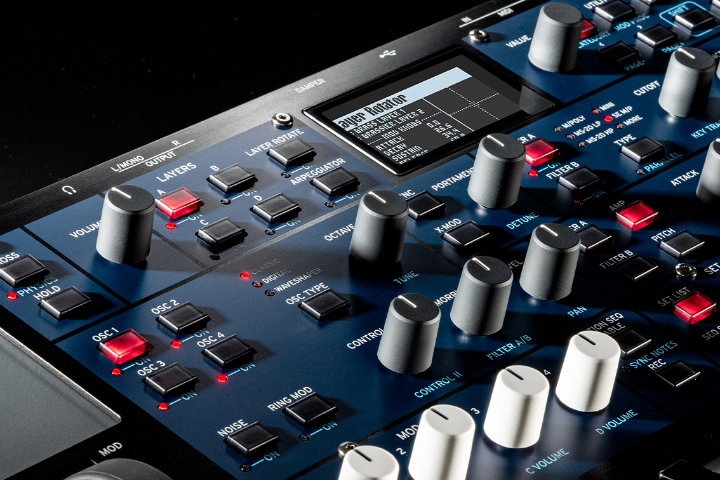
Just like in an analog synthesizer, these voice cards continue running even when not audible. For example, envelopes keep running so that when playing a pad sound with a long release phase, newly played notes pick up the envelope at its current point instead of starting from the beginning. Oscillators and LFOs maintain their phases, and resonance continues to fade out.
Envelopes are often an overlooked factor contributing to the unique sounds of vintage synthesizers. The multi/poly includes envelope presets from the Mono/Poly, MS-20, as well as others like "Mini," "Pro," "ARP Odyssey," and more. Additionally, analog VCAs don’t respond uniformly to voltages and have different thresholds for turning on and off, which significantly influences the character of the amplifier envelope. For this reason, the multi/poly offers modeled VCA behaviors from the Mono/Poly, MS-20, plus presets for "Mini," "Pro," "ARP Odyssey," and a linear variant.
Have you ever tried to replicate the portamento effect from your favorite song but failed to find the right setting, even switching between "constant value" and "constant time"? Classic analog synthesizers had different approaches to portamento, so the multi/poly provides six different portamento models to choose from.
Oscillators
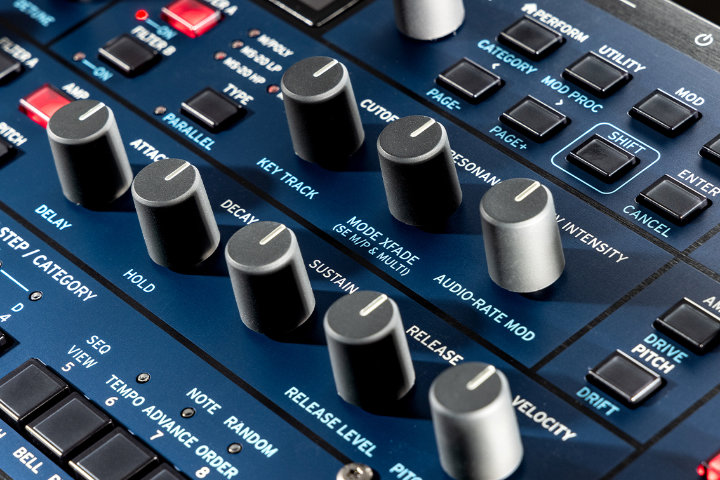
The multi/poly offers four oscillators per sound program for exceptionally fat, complex sounds. Each can include oscillator types "Classic," "Digital," or "Waveshaper." The "Classic" oscillator emulates traditional analog synth oscillators with impressive fidelity and density. Eleven different options include single and dual waveforms borrowed from vintage synths that could generate multiple waveforms simultaneously. Knobs on the panel provide direct access to parameters like pulse width, triangle tilt, mix of the two waveforms, and more.
The "Digital" oscillator can play wavetables with up to 64 steps, similar to early hybrid synths or modern Eurorack modules. Choose from over 200 factory wavetables or load your own via the editor/librarian software for macOS and Windows. Import wavetables from the modwave or convert wavetables from other popular software formats. Use over 30 modifiers to change how wavetables are loaded, resulting in subtle to drastic sound changes, and edit them in real time with 8 morph types like "Stretch," "Reverse," and "Mirror."
"Waveshaper" explores the realm of "West Coast" synthesis by processing simple waveforms (sine or triangle) through a shaper table. Gain modulation of the shaper creates glassy, dynamic overtones. Use the "Berkeley" shaper for traditional wavefolder sounds or choose from over 90 other shaper types. The multi/poly also uniquely offers modulated pulse width for an extra dimension of fullness and movement in the sound.
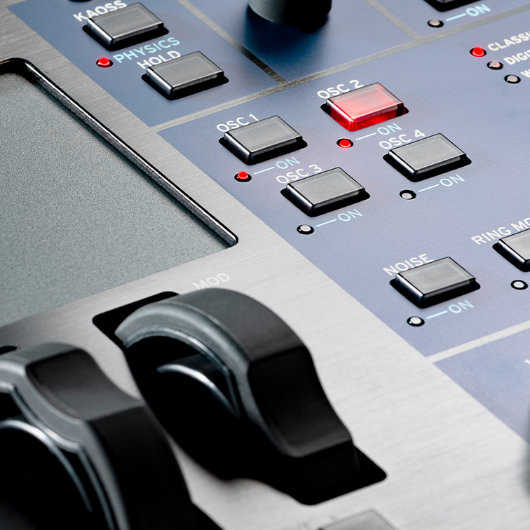
In addition to oscillators 1 to 4, there’s a separate noise generator with its own filter and saturation, plus a ring modulator with inputs for all these sound sources.
The multi/poly also offers the powerful oscillator sync and cross-modulation capabilities of the original Mono/Poly, allowing sounds only expected from large modular systems. Create unique sounds with oscillators 2, 3, and 4 following oscillator 1 for sync, cross-modulation, or both simultaneously. Alternatively, assign one of these functions to an oscillator pair and control it separately.
Dual Filter Models
All multi/poly filters have been completely redesigned, including a collection of superb vintage-sounding filters with authentic coloration and saturation. Five different self-resonant 4-pole models are available. "M/Poly" delivers the characteristic, dense sound of the classic KORG Mono/Poly. "Mini" represents the ladder filter of a popular American mono synth, reducing resonance in lower frequencies—important for classic bass sounds. "Pro" is based on the first programmable poly synth and offers powerful resonant sweeps down to the lowest frequencies. Lastly, self-resonant high- and band-pass filters "Ladder HP" and "BP" are also included.
The self-resonant "KORG 35" LP and HP filters with 12 dB/oct slope faithfully reproduce the distinctive, aggressive character of the legendary KORG MS-20. The "SE M/P" 2-pole filter is much gentler and allows blending between lowpass, band reject, and highpass, plus an additional bandpass mode.
Your sound creations can also be shaped with a wide selection of linear, resonant 2-pole and 4-pole lowpass, highpass, bandpass, and band-reject filters. Or explore new territory using KORG’s unique multi-filter, which enables modulatable blends of different filter modes.
All these filters can be modulated up into the audio range, producing bright, metallic, and bubbling effects that will make your sounds stand out. Use any oscillator or the ring modulator as a modulation source, or mix in the noise generator for especially chaotic timbres. In addition to the vintage filter saturation behavior, a separate drive circuit with anti-aliasing technology behind the filter section adds weight and texture to the sound—from subtle thickening to heavy distortion.
Finally, two of these filters can be used simultaneously, either in series or parallel. Sound programs provide two filter slots, A and B. Each sound source—including the four oscillators, noise generator, and ring modulator—has a balance control that crossfades between the two filters, opening a wide range of creative possibilities. Route one oscillator group through the M/Poly filter and another through the MS-20 low-pass filter. Create a classic serial highpass->lowpass chain but bypass one or more oscillators around the highpass filter. Because this is a continuous crossfade, not a simple switch, the balance between A and B can be modulated for unique effects. Filters can also operate in stereo, allowing separate panning of individual sound sources.
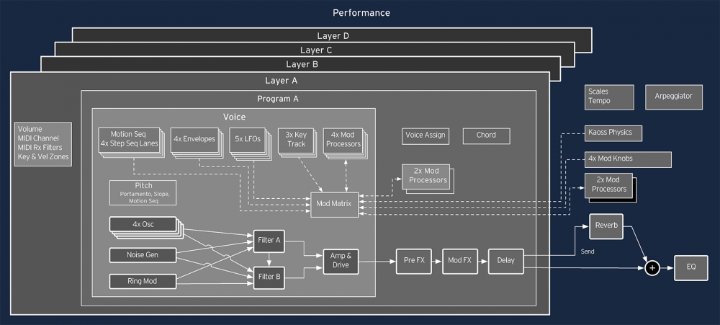
Structure of the multi/poly
Each sound program is based on four oscillators plus noise generator, ring modulator, sync, and cross-modulation. Edit these with two independent filters and modulate them via four loopable DAHDSR envelopes, five LFOs, and six modulation processors. Add complex multi-track modulations per voice with Motion Sequencing 2.0 and polish your creations with three studio-quality insert effect blocks.
But that’s just a single sound program! Combine up to four such programs into a performance. Switch between sounds in a "round-robin" style with the "Layer Rotate" function, triggered by key velocity or the arpeggiator. Use KAOSS Physics to create fluid, constantly changing modulations with simple swipes on the X/Y touchpad. Use the four programmable MOD knobs for intuitive control of multiple parameters simultaneously. Then refine the resulting sounds with two additional modulation generators, a master reverb, and a global equalizer.
Layer Rotate
The multi/poly has four layers, each capable of holding its own sound program. This allows creating layer and split sounds as well as velocity splits. Inspired by the paraphonic mode of the original Mono/Poly, which constantly switched between the four oscillators, the "Layer Rotate" function enables "round-robin" switching between complete sound programs.
Assign different sound programs to the four layers and switch between them with each key press. Play sounds in a repeating or random order. Trigger one, two, or three sound programs simultaneously at each step of a cycle. Or combine "Layer Rotate" with the arpeggiator for especially complex results.

Modulation and Control
With a control panel packed with knobs and performance aids, the multi/poly invites expansive sonic explorations. Oscillators, filters, envelopes, LFOs, and effects can be intuitively controlled via dedicated knobs on the front panel. Four programmable MOD knobs are precisely tailored to each sound program to get the best out of it. Use the knobs during your performance or save the results directly as new sounds. The "Hold" button sustains played notes or chords while you experiment with the knobs or play other instruments.
Add KAOSS Physics plus pitch bend and modulation wheels for uniquely expressive sounds that can be manipulated in real time.
Want to dive even deeper? Almost all front panel knobs and most parameters accessible via the display can be modulated, totaling over 5,500 potential modulation targets per performance! You can even modulate individual steps of motion sequences. Eight modulation processors are available to alter modulation signals through quantization, attenuation, curve shaping, and more.
Motion Sequencing 2.0
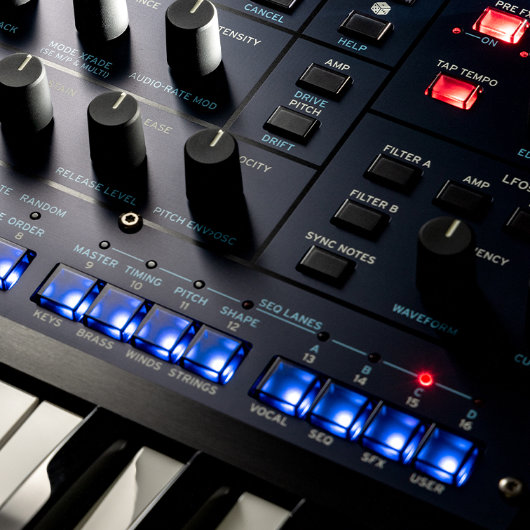
Motion Sequencing 2.0 was inspired by the wavestate’s Wave Sequencing 2.0. Timing, pitch, shape, and four sets of step sequence values are divided into "lanes," each with its own loop start and end points, enabling highly detailed and customizable modulation recording.
Each time the sequence advances, the individual lanes combine to produce the output signal. For example, a step sequence step might sound with different length, pitch, and shape each time it’s played. Loop points for each lane can be modulated per note via velocity, LFOs, envelopes, MOD knobs, or other controllers. In fact, each note of a held chord can play slightly differently!
Lanes can also randomly reorder step sequences for each pass. Steps can be randomly skipped with a probability adjustable from 0% to 100%. The result is organic, ever-changing sounds you can control at any time.
Kaoss Physics
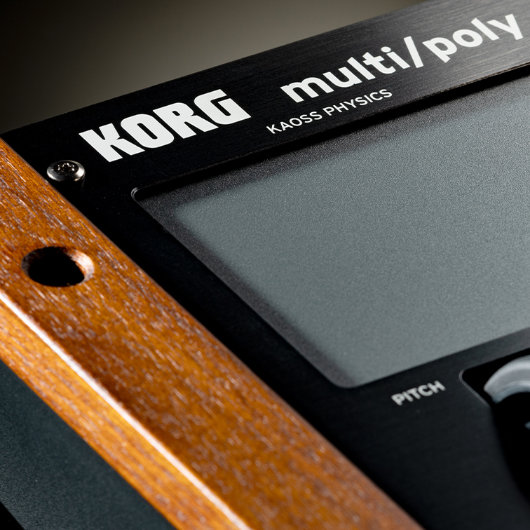
Kaoss Physics models a ball rolling on a surface and bouncing off walls. This surface can tilt in any direction. A bump with variable height/depth and selectable position attracts or repels the ball. Adjustable friction slows the ball’s movement, and a time parameter controls the overall speed. All these characteristics are modulatable and can be changed in real time.
Move the ball with a swipe on the X/Y touchpad or let it be controlled automatically by another modulation source. Dragging a finger across the touchpad also directly controls the ball. The ball’s position generates eight different modulation signals that can target any modulation destination: X and Y position, distance from center, angle relative to the X-axis, and separate signals for +/- X and +/- Y.
Walls can slow the ball as if padded or speed it up like in a pinball machine. Walls can also be removed entirely so the ball reappears on the opposite side, like in early computer games.
This virtual environment creates very specific modulation effects. For example, use a centered bump with negative height so modulation values always eventually return to zero. Or place a bump with positive height on one side or corner to keep modulation values away from that zone.
The result is an interactive controller that amplifies your physical gestures and turns them into complex, musical results. And did we mention it’s a lot of fun?
Production-Ready Effects
The multi/poly’s superb effects deliver production-quality sounds. Each layer has three dedicated effects plus a send path to the master reverb, followed by a parametric master equalizer. In addition to standard effects like compressors, EQs, chorus, flanger, phaser, and stereo delays, you’ll find specialized effects such as wave shaper, talking modulator, reverse delay, multiband mod delay, overb (known from OASYS and KRONOS), VOX guitar amp, VOX wah wah, vintage distortion, CX-3 rotary speaker, vibrato/chorus, multihead tape echo, plus a collection of classic guitar pedals in the extensive multi/poly effect suite.
Inspiring Random Function
Need more inspiration? A dedicated button marked with a "dice" icon generates new sounds using intelligent random functions. Randomize the entire sound or just selected aspects like oscillators, filter, or effects. Use the results immediately as new sounds or as an inspiring starting point for your own creations.
Set List Function and Smooth Sound Transitions
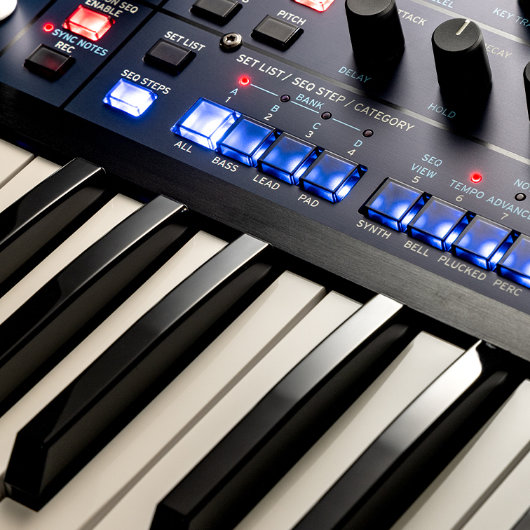
Set lists enable easy organization of your multi/poly performances and provide direct access during gigs or rehearsals. Smooth sound transitions allow previously played sounds and effects to fade out naturally even when a new sound has already been selected.
Connectivity Variety
Balanced stereo outputs allow professional connection to any recording or monitoring system. A headphone output is available for silent playing or stage prep. Classic MIDI jacks ensure connection to other MIDI-capable instruments or audio devices, and the multi/poly also supports class-compliant USB-MIDI connections to Windows and macOS systems.
Editor/Librarian Software
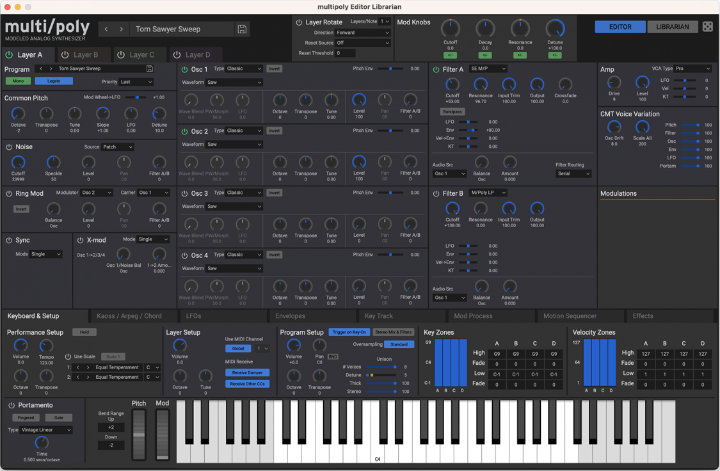
The multi/poly editor/librarian software allows editing and managing sounds via a macOS or Windows computer. Thanks to USB networking for high-speed communication, the software feels like a second control panel for the instrument. No separate synchronization or data transfer is needed. Graphical animations display modulations in real time—an invaluable aid for programming or adjusting sounds!
Free Software Package
The multi/poly comes with a versatile collection of music software to help take your productions to the next level—including iZotope’s Ozone Elements for AI-assisted mastering, a trial subscription for the piano teaching software Skoove to improve your playing skills, and software synthesizers from KORG and other manufacturers.
Built for the Stage
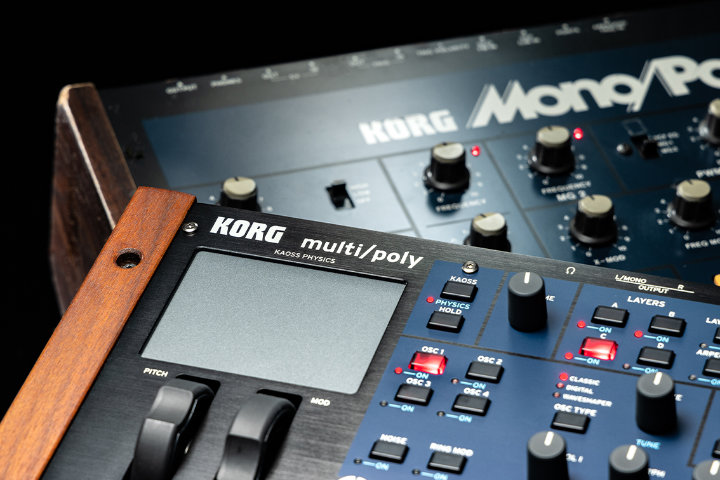
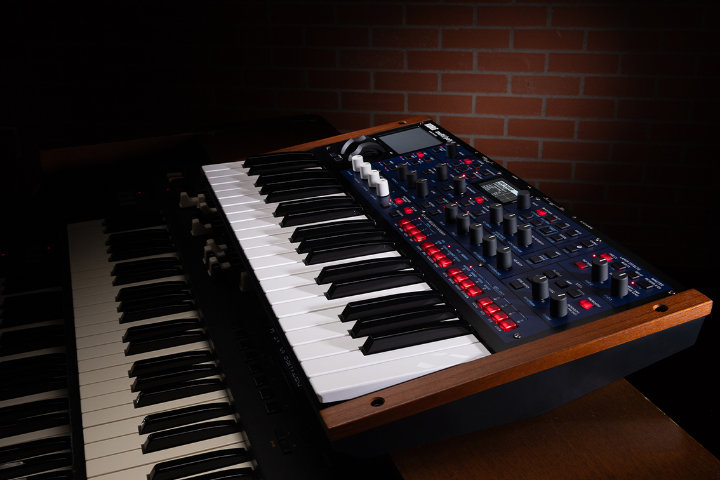
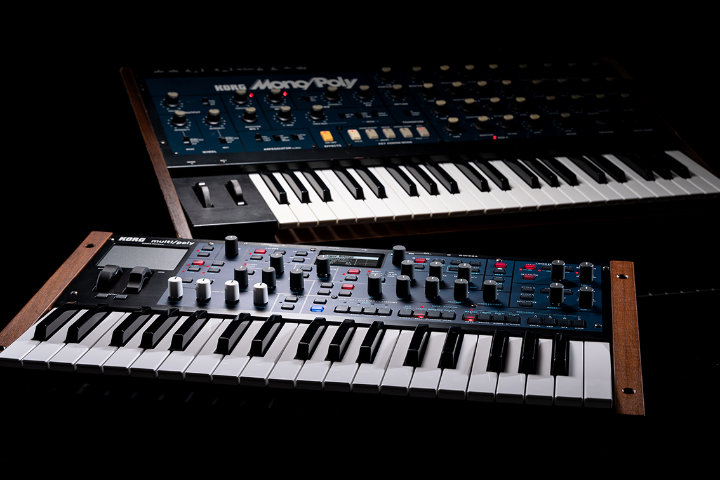
An instrument that sounds this good deserves a matching "look & feel." The new semi-weighted keyboard plays easily and expressively, and the knobs offer pleasant resistance for precise parameter changes. The solid aluminum panel is built for "on the road" use, and the attached wooden side panels plus the blue-black color scheme clearly pay tribute to the design of the original Mono/Poly.
Features
- Keyboard: 37 semi-weighted keys (velocity- and release-sensitive)
- Maximum Polyphony: 60 voices (may vary depending on settings)
- Sound Generation: Analog Modeling Synthesis
- Controls: Modulation Wheel, Pitch Wheel, Kaoss Physics, 4 "Mod" knobs
- Additional Modulation Sources: 4 Envelope Generators, 5 LFOs, 8 Modulation Processors, 3 Key-Tracking Processors, Sequencer Lanes A-D, Step Pulse, Step Pitch, Motion Seq On, Kaoss (X, Y, Distance, Angle, X+, X-, Y+ and Y-), Tempo, Program/Performance Note Count, Program/Performance Voice Count, Random (1+, 2+, 3+/- and 4 +/-), Constant Max, Poly Legato, Velocity, Exponential Velocity, Release Velocity, Gate, Gate+Damper, Note-On Trigger, Note-On Trigger+Damper, Note Number, Aftertouch and Poly Aftertouch (only controllable via external MIDI controllers), Pitch Bend (normal, +, -), MIDI CCs +/-, MIDI CCs +
- Modulation Targets: Most parameters can be modulated, with over 5,500 potential modulation targets per performance depending on programming
- Pre FX: Decimator, Graphic EQ, Guitar Amp, Modern Compressor, Parametric EQ, Red Compressor, Ring Modulator, Tremolo, Wave Shaper, Vintage Distortion
- Mod FX: Black Chorus/Flanger, Black Phase, CX-3 Vibrato Chorus, EP Chorus, Harmonic Chorus, Modern Chorus, Modern Phaser, Orange Phase, Polysix Ensemble, Small Phase, Talking Modulator, Vintage Chorus, Vintage Flanger, Vintage/Custom Wah, Vox Wah, CX-3 Rotary Speaker
- Delay: L/C/R Delay, Multiband Mod Delay, Reverse Delay, Stereo/Cross Delay, Tape Echo
- Master Reverb: Early Reflections, Overb
- Master EQ: Parametric 4-Band Equalizer
- Inputs and Outputs: Headphones (6.3 mm jack, stereo), OUTPUT L/MONO and R (6.3 mm jack, stereo (balanced)), Damper Pedal (6.3 mm jack, mono (half-pedal function not supported)), MIDI IN and OUT, USB-B
- Power Supply: External power adapter (DC 12V, 2,500 mA)
- Power Consumption: 5 watts
- Dimensions (W x D x H): 566 x 319 x 93 mm
- Weight: 3.5 kg
Scope of delivery
- 1 x Korg multi/poly synthesizer
- 1 x Power adapter
- 1 x Soft case
Specification
- Product number 00109780
- Sound Engine Analogue
- USB to host Yes
- Midi interface Yes
- with keyboard Yes
- Colour Blue
Write the first review
Share your experience and help others with their purchase decision. Review the product directly from the order history in your customer account.
Review nowQuestions about product
No questions have yet been asked about this article.
Financing with ConsorsFinanz
You can finance your order in convenient monthly installments from a value of €100.00.
- 6 to 72 months term
- 0% financing for 65,50 € per month
easyCredit instalment purchase
You can pay the purchase amount conveniently in installments. You will see immediately whether your application has been approved.
- 2 to 60 months term
- Financing from 21,00 € / month